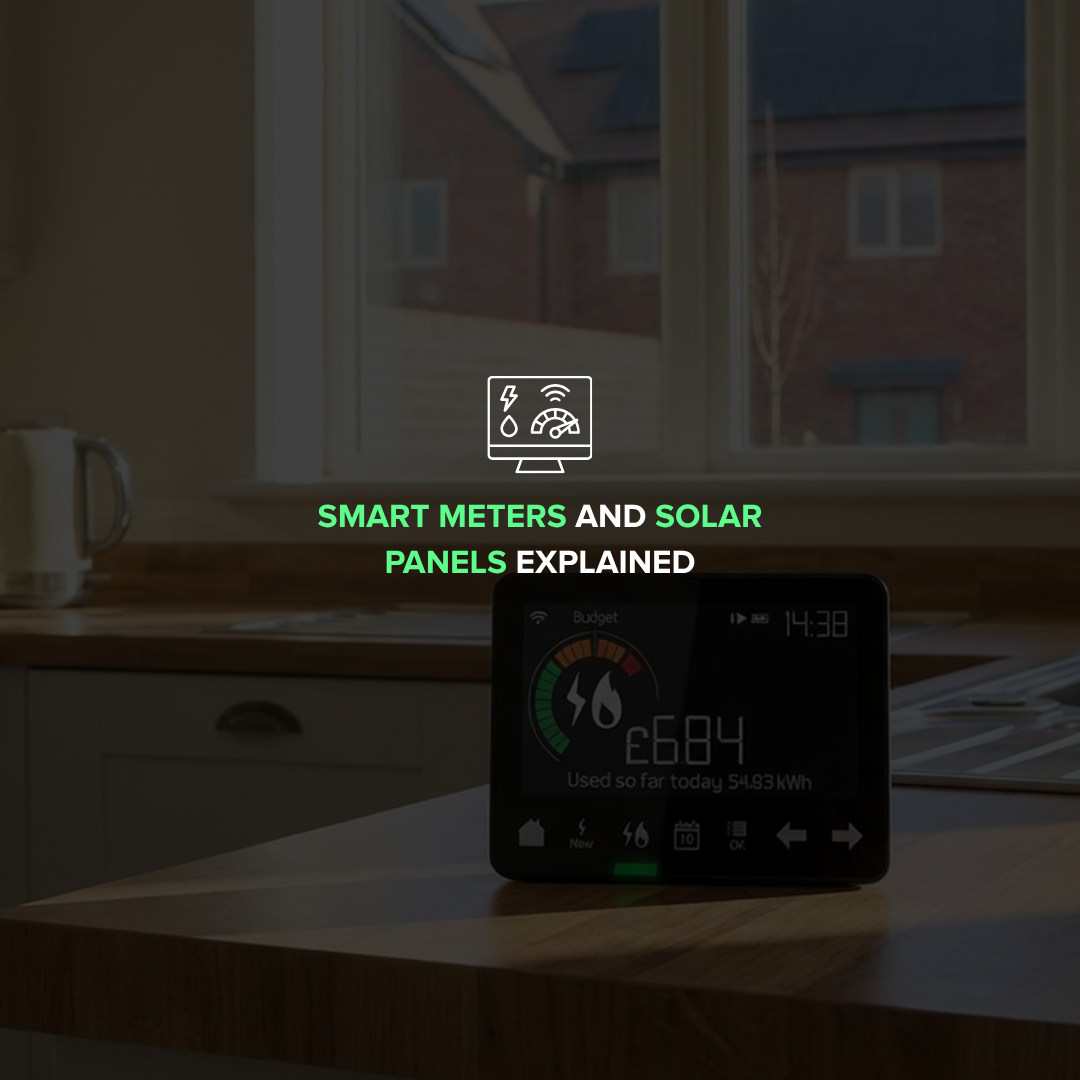


Smart meters and solar panels should work together, and for most homes, they do.
A compatible smart meter makes it easy to see what you’re using, track what you’re exporting, and get paid for any surplus electricity through the Smart Export Guarantee (SEG). In simple terms, it can help you make money from your solar.
However, depending on the type of meter installed, export tracking and payment setup are not always as straightforward as people expect.
At Apex Doma, we speak to homeowners every day who are looking for advice on how smart meters and solar panels work in everyday situations.
We’ll talk about what to expect from your smart meter and solar panel setup, how monitoring and export tracking function, and how smart meters connect to the SEG framework.
What Are Smart Meters?
Smart meters are digital energy meters that measure how much electricity and gas your property uses in near real-time. They automatically send readings to your energy supplier, which means bills are based on actual usage rather than estimates.
Traditional meters require manual readings, either submitted by the homeowner or taken during a visit. Smart meters remove this step and allow usage to be tracked more accurately.
For properties with solar panels and smart meters installed together, the system can also record electricity exported back to the grid.
Do Smart Meters Work With Solar Panels?
Smart meters and solar panels operate within the same energy ecosystem. After a solar system is installed, your home becomes both a consumer and a generator of electricity. A properly configured smart meter supports this setup by meeting your supplier’s billing and export arrangements.
Compatibility becomes important when registering for export payments or changing suppliers. The meter must be configured to reflect that your property exports electricity. If this step is missed, export payments may be delayed.
In a correctly configured system, they work together without conflict, supporting accurate billing, reliable export payments, and clearer overall energy management. If your system isn’t configured properly, there may be issues.
If you need help checking your smart meter and solar setup, speak with us today.
How Smart Meters and Solar Panels Work Together
Smart meters work with your solar panels to make the most of your energy. To understand how they do this, it helps to look at how electricity moves through your home. During daylight hours, your solar panels generate power from sunlight.
That electricity prioritises your property first, running appliances, lighting, and other electrical devices before any interaction with the wider power network.
If your system generates more electricity than your home needs at that time, the excess energy flows into the local electricity network. Smart meters with solar panels record this two-way movement of electricity, capturing both imported and exported power as it happens.
To be able to register your exported energy, your property must have a Meter Point Administration Number (MPAN). This unique reference identifies your home as a registered electricity generator within the grid system.
With this in place, smart meters and solar panels operate as a coordinated system of generation, usage, and export.
First vs Second-Generation Smart Meters (SMETS1 vs SMETS2)
There are two main types of smart meters in the UK:
- First-generation (SMETS1).
- Second-generation (SMETS2).
Both record energy usage digitally, but there are important differences that affect compatibility and reliability.
SMETS1 meters were introduced first. Some early models experienced communication issues after a supplier switch, which could interrupt data sharing, with reports that there were issues measuring exported energy.
SMETS2 meters were developed to resolve these limitations. They connect through the Data Communications Company (DCC), a central network that allows meters to remain fully functional even if you change suppliers.
This makes SMETS2 meters the best choice for properties generating electricity. In some cases, energy suppliers may offer to replace older first-generation meters during a solar installation or routine upgrade if export functionality is limited.
If you would like to learn more about smart meters and solar systems, explore our Solar Advice Hub for practical guidance and further information.
Do You Need a Smart Meter for the Smart Export Guarantee (SEG)?
In most cases, yes. To receive payments under the SEG, your energy supplier must be able to measure how much electricity your solar system exports.
The SEG allows households to earn money from surplus electricity sent into the electricity network. Suppliers offer export tariffs, paying you for the units your system generates beyond what your home uses.
This means SEG payments can offer some income or offset your costs, separate from the savings you make by using renewable energy.
To generate payment, you’ll need accurate export readings. Smart meters with solar panels enable suppliers to collect verified export data automatically. Without a compatible smart meter, some households may not be eligible for certain tariffs or may be placed on fixed export estimates.
Why Some People Think Smart Meters and Solar Panels Don’t Mix
Some homeowners are unsure how smart meters work with solar panels. This uncertainty usually comes from early rollout issues and confusion around export readings, rather than from any technical incompatibility.
When installed and registered correctly, modern smart meters are fully compatible with solar PV systems. They record imported electricity and, where configured, measure exported energy for SEG payments.
Most confusion tends to come from a few specific situations:
- Early first-generation smart meters (SMETS1) – Some SMETS1 meters installed before 2019 lost smart functionality after supplier switching. In certain cases, export readings weren’t clearly communicated. Modern SMETS2 meters were introduced to resolve these limitations.
- Export registration issues – Export MPAN details may not have been properly registered with the energy supplier, delaying SEG payments.
- In-home display (IHD) limitations – Most IHD screens clearly show imported electricity but don’t display exported energy in an obvious way. This can create the impression that solar exports are not being recorded, even when they are.
- Configuration errors at installation – If export settings aren’t configured correctly, readings may not be transmitted properly to the supplier.
To avoid common setup issues, request a solar quote from Apex Doma and start with the right configuration.
Smart Meters and Solar Panels FAQs
Yes, smart meters are compatible with solar panels. When properly installed and registered, they record both imported and exported electricity, supporting accurate billing and Smart Export Guarantee payments.
Most issues arise from setup errors or older equipment, not from any technical incompatibility between the systems.
Absolutely. Your supplier will configure the meter to recognise that your property generates electricity. Once registered correctly, it can support export tracking and Smart Export Guarantee payments.
Smart meters don’t directly measure total solar generation. They record the electricity you import from the grid and the surplus you export.
If you want to see how much power your solar panels produce in total, you’ll need a separate generation meter or access to your inverter’s monitoring system.